
What is the Future of AI in Architecture Visualization?
Discover how AI is shaping the future of architecture visualization with faster workflows, smarter rendering, and photorealistic design.

Architecture visualization is evolving rapidly with the rise of artificial intelligence. Tasks that once required hours of manual work can now be completed in minutes using AI powered tools and automation. From generating design concepts to enhancing render quality, AI is helping architects and 3D artists work faster and more efficiently.
As technology continues to improve, AI is becoming an important part of modern architectural workflows. While it does not replace creativity or technical expertise, it significantly improves productivity, visualization speed, and design exploration.
How AI is Changing the Architectural Visualization Industry?
AI is transforming the architecture visualization industry by automating repetitive tasks and accelerating rendering workflows. Designers can now generate concept visuals, enhance lighting, upscale images, and create multiple design variations with minimal effort.
Modern AI tools also help studios reduce production time while maintaining visual quality. This allows architects and visualization artists to focus more on creative direction, storytelling, and client communication instead of spending excessive time on technical adjustments.
What are the Key Benefits of AI in Architecture Visualization?
Faster rendering and image generation
Quick concept visualization for early stage projects
Automated lighting and material suggestions
AI based image enhancement and upscaling
Faster design iterations and revisions
Improved workflow efficiency for studios
Reduced production costs and render times
Better client presentations with realistic visuals
Easier experimentation with multiple design styles
Enhanced post production workflows
Popular AI Tools Used in Architecture Visualization
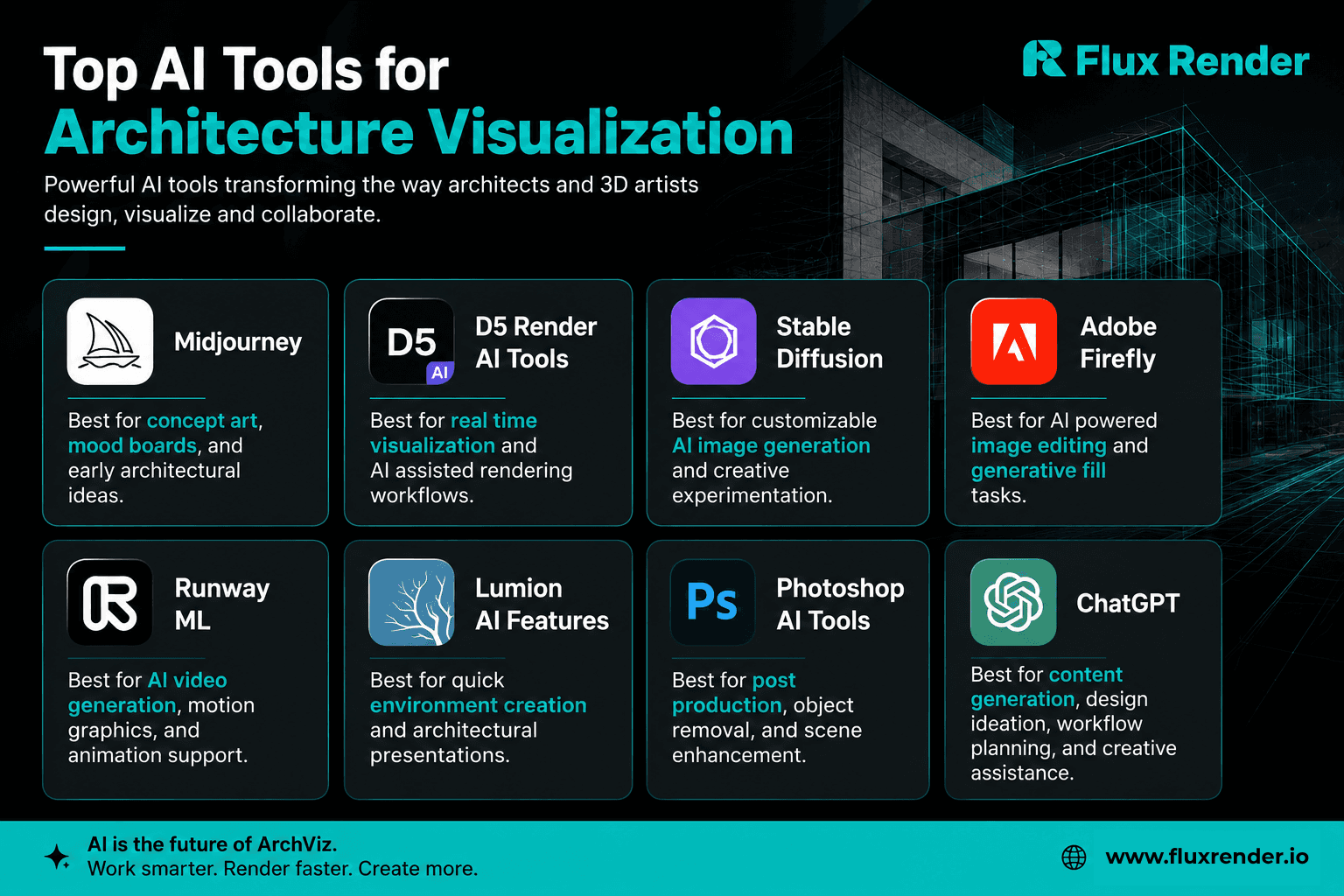
Midjourney - Best for concept art, mood boards, and early architectural ideas.
D5 Render AI Tools - Best for real time visualization and AI assisted rendering workflows.
Stable Diffusion - Best for customizable AI image generation and creative experimentation.
Adobe Firefly - Best for AI powered image editing and generative fill tasks.
Runway ML - Best for AI video generation, motion graphics, and animation support.
Lumion AI Features - Best for quick environment creation and architectural presentations.
Photoshop AI Tools - Best for post production, object removal, and scene enhancement.
ChatGPT - Best for content generation, design ideation, workflow planning, and creative assistance.
AI vs Traditional Architectural Visualization Workflows
Feature | AI Workflow | Traditional Workflow |
Rendering Speed | Very fast | Time consuming |
Design Iterations | Quick and automated | Mostly manual |
Cost Efficiency | Lower operational costs | Higher hardware and labor costs |
Creativity Control | AI assisted | Fully manual artistic control |
Learning Curve | Easier for beginners | Requires advanced technical skills |
Realism Quality | Improving rapidly | Highly refined and accurate |
Flexibility | Excellent for experimentation | Better for precise customization |
Production Time | Reduced significantly | Longer production cycles |
What are the Challenges and Limitations of AI in ArchViz?
AI generated visuals can sometimes lack accuracy
Limited control over detailed geometry and technical precision
Inconsistent outputs across different prompts
Over reliance on AI may reduce originality
Some AI renders still require manual post production
Licensing and copyright concerns with generated content
High quality AI tools may require powerful hardware
AI cannot fully understand architectural functionality or construction requirements
How Architecture Studios Can Prepare for AI?
1. Learn AI Powered Tools
Studios should start exploring AI rendering, image generation, and automation tools to stay competitive.
2. Combine AI with Existing Workflows
AI works best when integrated with traditional 3D software and rendering pipelines.
3. Train Teams on AI Assisted Production
Artists and designers should understand prompt engineering, AI enhancement, and workflow optimization.
4. Focus on Creativity and Storytelling
Human creativity remains essential for creating meaningful architectural experiences and emotional visuals.
5. Upgrade Rendering Infrastructure
Faster hardware and cloud rendering solutions help studios maximize AI workflow efficiency.
6. Stay Updated with Industry Trends
AI technology evolves quickly, so continuous learning is important for long term growth.
Final Thoughts on the Future of AI in Architecture Visualization
AI is shaping the future of architecture visualization by making workflows faster, smarter, and more accessible. From concept generation to post production, AI tools are helping studios improve efficiency while reducing production time.
However, the future of ArchViz will not be fully automated. Human creativity, design understanding, and artistic direction will continue to play a major role in producing high quality architectural visuals.
As AI workflows become more demanding, powerful rendering infrastructure will become even more important. Platforms like Flux Render can help studios and artists handle complex rendering tasks faster with scalable cloud rendering solutions.

Frequently Asked Questions
Will AI Replace 3D Artists and Architects?
No, AI will assist artists and architects rather than replace them. Human creativity, technical knowledge, and design thinking are still essential.
What are the Future Trends of AI in Architecture Visualization?
Future trends include AI generated 3D scenes, real time AI rendering, generative design, AI animation tools, and VR or AR integration.
Is AI rendering better than traditional rendering?
AI rendering is faster and more efficient for concept generation, while traditional rendering still offers better precision and artistic control for final production work.
What is the Role of Human Creativity in AI Driven Visualization?
Human creativity guides the design vision, storytelling, composition, and emotional impact that AI alone cannot fully replicate.